|
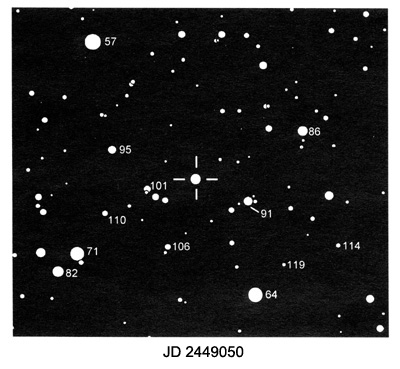
Observing Stellar HeartbeatsLook at the simulated reproduction of
a star field below. It contains a variable star that is located in the
middle of a set of crosshairs, and surrounding the variable star are
several comparison stars of known magnitudes. These stars, which do not
vary in brightness, are used to compare the changing brightness, or
magnitude, of the variable star. Knowing the values of the magnitudes of
the comparison stars, you can estimate the magnitude of the variable star
as it changes over time. On a star chart, different magnitudes are
portrayed as different sizes - the brighter the magnitude the larger the
size of the star, and the dimmer the magnitude the smaller the size of the
star. Magnitudes have one decimal, such as 6.3 - however in star fields,
the decimals are not indicated. A magnitude of 6.3 is written as 63 so
that the fields are not as cluttered and the decimal points are not
mistaken for stars. When you record your magnitude estimation you need to
include the decimal.
Print out the
table provided. Estimate the magnitude of the variable
star on the first picture of the star field using the magnitudes of the
stars around it. Proceed through each of the pictures and place your
estimated magnitudes and the corresponding Julian Day (JD) numbers in the
table.
Ask your students to look closely at the first plate. Question them about what
they see in each plate. Suggestions are:
- How is the target variable star marked? (with crosshairs)
- How are comparison star magnitudes designated? (Emphasize the backward-nature
stellar magnitude. Brighter stars are indicated with large dots and a SMALL number,
dimmer stars with smaller dots and larger numbers. A useful analogy is 1st place,
2nd place, as in a race.)
- Is there a star of magnitude 5.7? What do you notice about it's representation?
(The magnitude is written as 57, so that decimal points are not confused with stars.)
- Look at the JD numbers below the plate. What do you notice about the numbers
(The dates are sequential and part of the number, "2449", is repetitive. Plates can be
uniquely identified with only the last three numerals.)
- Does the target variable star have the same magnitude on any of the plates (Yes,
look at JD +300 and JD +435.)
|